
Parallel Experiences
Biographical Notes 1

At about age 18, I made a bicycle trip from Rotterdam to Amsterdam, with a girlfriend, and we were going to some kind of a party. I think it was about a six hour trip and naturally we were staying overnight. One thing I will never forget is how I was listening with growing amazement as someone was asking my girlfriend about the trip, and I realized that all the landmarks she mentioned were completely different from if I had told the story. It was one of the most vivid experiences ever of how we are all in our own perceptual bubble, and even the extent to which the Venn diagrams appear to overlap, it may not be that simple. For certainly our Venn diagrams overlapped for the trip, except they did not, for geographically we covered the same distance, and we left together, and we arrived together, but we had two different trips.
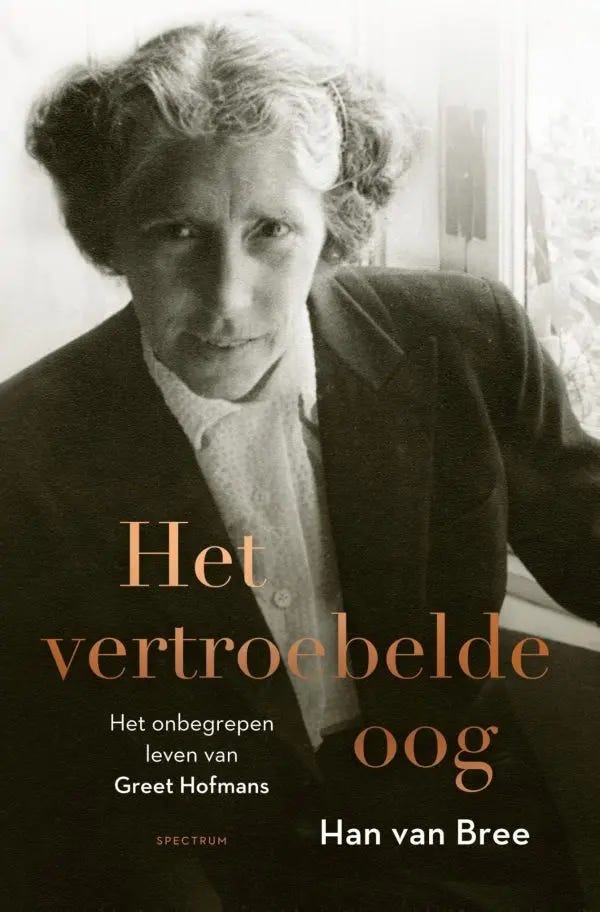
I am just having a similar experience, by reading the book Het Vertroebelde Oog, by Dutch historian Han van Bree. The English title might be The Clouded Eye, but there is no translation available. The book is the story about Ms. Greet Hofmans, who was a channeler of Jesus, who I knew since I was three years of age. The reason some historian would take an interest was because Ms Hofmans was friends with Princess Wilhelmina (the retired queen-mother) and her daughter Queen Juliana. The connection came about because the youngest princess was born om 1947 with somewhat cloudy vision, apparently because the Queen had had rubella while pregnant with her. And there was hope that intercessory prayer by Ms. Hofmans might appeal to God’s Help (read: Jesus) and facilitate healing. The healing of the eyes did not make progress, however in other ways, Ms. Hofmans was experienced as very helpful by some, and by others not so much. Prinses Marijke, who later went by the name of Christina van Oranje, and was married to a Cuban exile, Jorge Guillermo, who she met in New York, and they lived in New York and later in the Netherlands.
At the time (shortly after World War II), the Queen and Prince Bernhard were together again after the war had separated them for five years. The prince was a bit of a playboy, but apparently had an open mind as to some paranormal capabilities that some people seemed to have, and Ms. Hofmans had a growing reputation at the time.
After Ms. Hofmans began to figure out some of what Prince Bernhard was up to, and counseled the Queen accordingly, and also did not let the prince use her to convince the Queen of things he wanted her to do, Prince Bernhard began to oppose her and eventual this led to a lot of negativity, and rumor mongering by the Prince, including having a nasty article published in the tabloid press )Der Spiegel) in Germany. Eventually, it became a national crisis, with a risk of a royal divorce, and finally Queen Juliana gave in to political pressures, and severed relations with Ms. Hofmans, including firing the members of her staff who were also friendly with her.
My experience was that once a month, Ms. Hofmans would stay with us and have a day to receive people at our house, in my father’s study (he was a psychiatrist, and he would take the day off for the occasion). I first met her when I was three years old. I was deeply impressed and always happy to see her, and happily accepted whatever channeled guidance might come through her. Ms. Hofmans always assured us that all God’s children can always call for his Help (the etymological meaning of the name Jehoshua is God’s Help), and that strictly speaking we did not need her or anybody to intervene for us, she was just there to show the way, to teach us how to ask for help. The first major lesson I was taught about God’s Help, was that God was not like Santa Claus - asking for Help was not like giving your wish list and hoping for the best. Instead, asking for Help meant surrendering your idea of what the outcome might look like, and completely placing the outcome in the hands of God’s Help.
Reading the book now, is for me an amazing experience of multiple parallel stories, for many, many of the people mentioned in it, I knew when growing up. And naturally, I knew my own family, so there is the private story of growing up, and the parallel stories of many of the people I knew growing up, and often fills in details that I was too young to grasp at the time. It starts with my sister, who had an aversion to Ms. Hofmans from very early on, as much as I was always happy to see her, and eagerly sought out the guidance that she was able to channel for me, which continued into my early teens. I remember exactly how my sister got her aversion to Ms. Hofmans. She is two and a half years my younger, and when she was a toddler, there was a time when she would try to eat whole oranges, peel and all. It drove my mother to distraction, and my mother at one point asked for guidance through Ms. Hofmans. She then proceeded to make the mistake of using the name of Ms. Hofmans as an authority, so now Ms. Hofmans was to blame for the fact that my sister could not always get what she wanted. So one parallel story, is the very different experience and interpretations of my sister, as told to the author, Han van Bree. [Note, I made a few minor edits for accuracy, such as my mother’s name, which the book reports as Gerie, but it was Gery.]
The blow: Gaudola van Vlissingen
In the choir of young adults that sang Hofmans’ praises, Gaudola van Vlissingen was a dissonant voice. From a young age, she had an ‘intuitive aversion to that person’, or rather: to the sublime adoration of adults for Hofmans (based on an interview with the author on November 5th, 2021). This was especially true for her parents Reinoud and Gery Fentener van Vlissingen, who besides Gaudola (1953) had two other children: Rogier and Machteld. The family lived in the Kralingen district of Rotterdam. Reinoud and Gery were members of the Remonstrance church by birth1, but not religious. They did say prayers before meals: not with folded hands, but with open ones. Gaudola’s parents had great confidence in Hofmans: the only framed photo in the large house was a portrait of the messenger. Gery told her daughter with awe that Hofmans had once lived ‘in a chicken coop’.2
Reinoud was a psychiatrist and a follower of Carl Jung3. He had a practice at home and worked one day a week in prison. He refused to prescribe pills and rejected vaccinations, because just like Hofmans, his starting point was: God is our doctor. He sent some patients to his wife, who had studied law and psychology. Those who she also did not know what to do with were referred to Hofmans. Among them was the wife of a convicted pedophile. The channeler (i.e. Ms Hofmans as the channeler of “God’s Help) told the woman that her husband was ill and that she should therefore not judge him, but accept him. It was valuable advice for the woman in question, who felt supported – according to Gaudola.
Reinoud and Gery also asked Hofmans for advice, including about their eldest daughter's wish to go to the Werkplaats in Bilthoven, the school of Kees Boeke. The channeler realized that this was a good plan. Gaudola, then 14, left Rotterdam to temporarily move in with the pediatrician Wim Kooper, his Danish wife and their three children. They were also members of Hofmans’ circle of acquaintances. When she stayed with the Koopers, Gaudola developed eczema on her head. Hofmans did not allow her to wash her hair for a while. She obediently complied, until she suffered a concussion and ended up in bed. After a while, mother Kooper had had enough of her increasingly greasy hair and ordered Gaudola to use the shampoo bottle. ‘That was not allowed, of course, but it felt wonderful to have such a clean head’, Gaudola said in retrospect. It was a sign of Hofmans’ authority, even though the Koopers were less dogmatic about it than Gaudola’s parents. The Koopers believed that you should continue to think for yourself and had no objection to vaccinations, for example. The eczema eventually disappeared by itself.
* * *
A few times a year Hofmans stayed with the Fentener van Vlissingen family in Kralingen4. They held evenings for Q&A, for which the living room was filled with rented folding chairs. The good crockery and beautiful tablecloths were also taken out of the cupboard especially for the special guest – while Hofmans herself, according to Gaudola, actually didn't care about such things. Although Hofmans didn't come often, the largest bedroom on the second floor was always kept free for her. That irritated Gaudola, who was fobbed off with a small bedroom himself.5
During one of the sleepovers, things went wrong between the channeler and the young girl. When they happened to meet each other on the landing, Hofmans said 'hi child' and picked her up without asking. Gaudola then screamed 'let me go!' and hit the channeler in the face with the flat of her hand. Stunned, she put the girl down again. In that explosion, all frustration erupted: about the preferential treatment Hofmans received, about the mostly empty large bedroom, about the adoring attitude of her parents, about ‘that divine whining’. Looking back, Gaudola also called the lifting a form of unwanted intimacy. Yet she assumed that Hofmans had only wanted to be nice.
Gaudola described Hofmans as ‘coarsely built’, ‘unfeminine’ and ‘probably asexual’. Despite her aversion, according to Gaudola, the giver was certainly not a charlatan, she was not out for success and she sincerely believed that she had a higher mission to fulfill. She was not a bad person – and certainly not a witch. In Gaudola’s view, it was therefore not Hofmans who went too far, but her followers - especially her father who unreservedly followed the channeler6. Reinoud was not only an anti-vaxxer avant la lettre, but also believed that their multiply handicapped daughter Machteld – just like Princess Marijke, for example – was a ‘child of God’, sent to them with a purpose7. He also received messages from above and considered himself Hofmans' logical successor.8
Two years after Hofmans' death, Reinoud informed his family that God had ordered him to leave. He moved in with a 'patient' and continued his practice with another woman. The family was left in poverty: the promised money for the education of the two eldest children would never be paid, according to Gaudola.9 But Hofmans could of course do nothing about that10.
[translated from Het Vertroebelde Oog, by Han van Bree, 2025)]
I regret that the author did not interview me during the writing of the book, but I offer some comments and corrections via footnotes, partially corrections of fact, and in a few cases simply different interpretations.
Many parallels
Obviously, in this particular section about my family, there is the parallel experience of my sister. She is a Cancer, and I am a Capricorn with Aries rising and ascendant. All of our lives, we seem to have short periods that we get along fine, but then what I like to call “ice ages,” when there is no contact. Reading her account of this part of our shared experience growing up was certainly very interesting.
Alongside that, there are the many stories about people I knew, and my own relationship with Ms. Hofmans, which was so very different from my sister´s. And finally, there is the heroic effort of the author, Han van Bree, for before him, the ‘generally accepted,’ reading of the relationship of the Queen with Ms. Hofmans, was mostly seen as an unfortunate incident, and possibly a brush with mental incompetence on the part of the Queen. Prince Bernhard had attempted to have the Queen institutionalized. Wikipedia offers a half-way decent account of the story of Greet Hofmans. Given the avalanches of negative publicity that followed the crisis at the royal palace, Soestdijk in 1956, and the removal of Ms. Hofmans and her entourage from the property, again this boek is an absolute masterpiece of objectivity, and evenhanded reporting, that is at least a start for a very different look at this interesting period of Dutch history. Certainly Queen Juliana and Queen Wilhelmina before her where profoundly religious people, and history has insufficiently come to grips with those aspects of how they looked at their own roles. A re-evaluation is in order, and this book definitely opens the door.
For me personally also, the experience of reading this now is an interesting journey in terms of looking back on personal development.
My parents were not in the Remonstrance church by birth. I am not entirely sure if, and how they were baptized, but while the overall culture in Holland was obviously Christian, I was aware that my mother was in the Oxford movement during her college years. She had a law degree, but never practiced as a lawyer, and she was pursuing a study of psychology, which was how she met my father, who was studying to become a psychiatrist. They chose the Remonstrance church as simply a church that seemed liberal enough to suit them, but gradually they realized that they were more “spiritual, but not religious,” and they left the church some time between my birth and my sister’s. That was also the time when they met Ms. Hofmans, and began to focus more on our individual connection to our Creator and Source.
The chicken coop story is told elsewhere in the book, and it is only somewhat true, since at one point Ms. Hofmans had lived on the estate Molecaten, and a small house was built from her, in which some of the wood indeed came from a large chicken coop that was no longer being used.
To add some precision, my father was indeed a psychiatrist, but he very early on recognized that psychiatry was headed down the wrong track by relegating psychiatric problems to the realm of biochemistry, and he patently refused to prescribe psychopharmaca, and evolved in to more of a Jungian psychotherapist, and advertised himself as offering talk therapy only, similar to what Dr. Peter Breggin is practicing in the US today. My father understood that the psychiatric problems were spiritual/psychological issues, and he anticipated the wave of medical problems resulting from psychopharmaca, and he got out of the way, while Breggin, a generation later in the US, saw the wave crashing into the shore and appreciated the damage from psychopharmaca. He likewise practices talk therapy only.
As noted earlier, already when we lived in Jutphaas, a village by Utrecht, in the early fifties, Ms. Hofmans had a regular monthly day of consultations in my father’s study in our little house at the Hooftgraaflandstraat 121A. This then continued when we moved to Rotterdam in 1955.
I remember these bedroom battles. It resolved itself later, when Ms. Hofmans ceased her sessions in Rotterdam, and my sister moved into the bigger bedroom in the back of the house.
This is a good observation, related to the story of the oranges. Gaudola was able to a degree to separate Ms. Hofmans as a well intended person, and her reaction ultimately was really a normal drive of wanting to assert herself in the face of parental authority.
Obviously, there was simply an overall spiritual awareness, that nothing is for nothing, that reality all fits together seemingly and that the things we experience in life are not “accidents,” but “God’s blessings,” and that the issue with anything the shows up on our path is about our acceptance of the opportunity for healing that is always present in everything. This insight would also be the foundation of the opposition to vaccination, which was really about acting on the fear of avoiding normal childhood diseases, and that it was healtier to have them, than to avoid them. Today we know this is the case. I knew it when I was seven or eight, when I asked my father why it was that the vaccinated children were sick all the time. Today, thanks to the work of Dr. Paul Thomas and others, we know this to be true. In short, the idea that “God is my doctor,” is too limited, and does not capture it. It tends to the direction of Christian Science, and my father did not reject medicine on that level, we did go to doctors if needed, be it mostly either anthroposophical or homeopathic. He very specifically rejected psychopharmaca and vaccinations for clear and very explicit reasons, which he could explain.
I do not have any specific evidence of this, and it may be more of my sister’s interpretation. The environment around Ms. Hofmans was such that all God’s Children have a direct connection with our Creator and Source, God, and thus it was only a matter of clearing out the channel in order to be able to hear, and in some cases maybe be able to provide guidance to others.
This is accurate. I remember being in college in Leiden, studying Sanskrit and Comparative Linguistics, and receiving a note from my father, who was then married to his second wife, Tine Verbon, and telling me how he was no longer able to pay for my studies, and how he had faith in my usual creativity and succeed regardless.
Hofmans had died in 1968 (November 16th, 1968), so this comment is moot.